
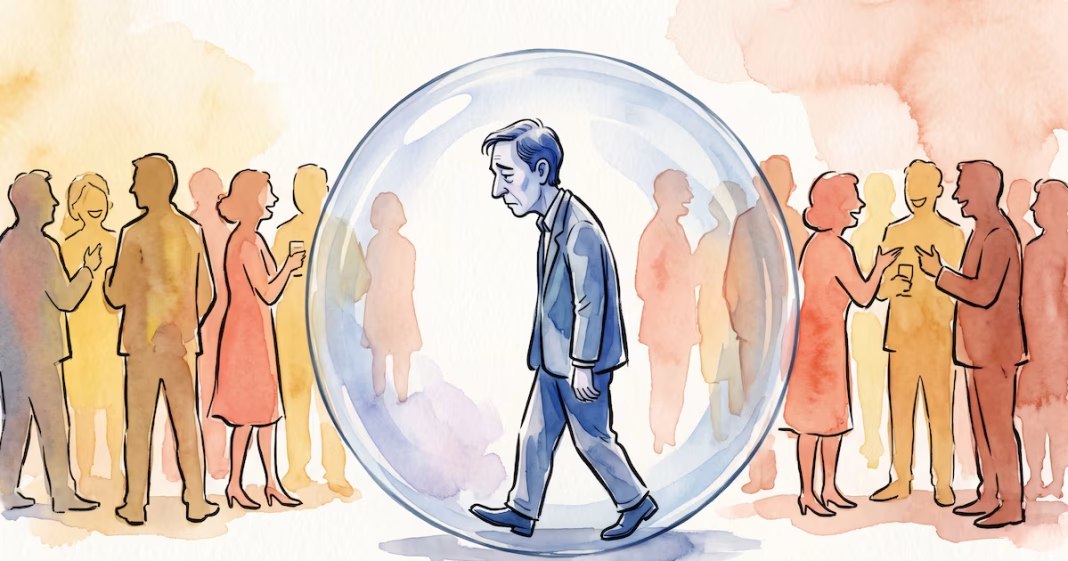

The loneliness and the social isolation do not describe the same experiencealthough they usually appear together in conversations about well-being and health. The first refers to the perception of lack of meaningful tieswhile the second is related to limited social contact. The World Health Organization warns that social disconnection affects one in six people in the world, according to a 2025 report.
The difference between both phenomena becomes relevant because having a active agenda or keep frequent contacts It does not guarantee that a person feels accompanied. The opposite can also be true: someone with a reduced social network may not experience loneliness. That distance between the observable situation and the personal experience is the starting point of recent research from Cornell University.
As published EuronewsThe work examined how this difference is associated with health over time. The discovery does not prove that perceived loneliness causes illnessbut suggests that evaluating only the number of links may leave out a relevant part of the problem.

The World Health Organization warned that social disconnection affects one in six people in the world (Illustrative Image Infobae)
The study, published in Social Asymmetry and Risk of Morbidity and Mortality, analyzed data from 7,845 adults 50 years or more residing in England. The research followed the participants for an average of 13.6 years and compared their levels of social isolation with the loneliness they reported feeling.
The authors called social asymmetry to that difference. Social isolation was evaluated based on indicators such as contacts, participation and network of relationships. Loneliness, on the other hand, was measured as a subjective perception of disconnection. The asymmetry appears when both dimensions do not match.
Those who felt lonelier than their level of isolation suggested were classified as socially vulnerable. Compared to people with low loneliness and low isolation, this group presented an association with a 13% higher risk of death for different causes, 16% higher cardiovascular disease and 21% higher rate of chronic obstructive pulmonary disease. The latter is a condition that makes it difficult for air to circulate in the lungs.
In contrast, participants who had less social contact, but did not feel lonely, showed few associations with health problems observed. The researchers described them as socially resilient. The result suggests that the number of relationships, aloneit does not reflect how each person experiences their bonds.
Antonio Ongprofessor of Psychology and director of the Human Health Labs of the Cornell UniversityHe pointed out in statements reported by Euronews that two people with similar social circumstances can go through different health trajectories depending on how they experience those circumstances. The research is observationalTherefore, it identifies associations and does not allow us to conclude that one variable is the direct cause of the other.

A Cornell University study analyzed data from 7,845 adults aged 50 or older in England for an average of 13.6 years (Illustrative Image Infobae)
The Cornell study adds to a broader discussion about the impact of social ties in health. A systematic review and meta-analysis of 90 cohort studies gathered information from 2,205,199 people and found associations between social isolation, loneliness and higher mortality from different causes.
The authors of that review, published in Nature Human Behaviorpointed out that both phenomena must be analyzed with caution because the results vary depending on the population, monitoring and how to measure social relations. The work does not present loneliness and isolation as equivalent conditions, but as different factors which may coincide or appear separately.
The Cornell research provides a criterion to observe this difference. Instead of limiting the evaluation to number of people availableproposes to consider whether there is a mismatch between the observable links and the feeling of disconnection. This perspective does not replace other social or health indicators, but it allows incorporating the declared experience for each person.
The report of the World Health Organization argues that loneliness and social isolation have effects on physical, mental health and well-beingand that require responses in the community, health and public policy spheres. Furthermore, it distinguishes both concepts and suggests that the measures should be based on adequate information about each situation.
Results available they do not enable universal recommendations nor unique solutions. They do reinforce the need to avoid a simplified reading of social life: The frequency of contact may be important, but it does not in itself determine whether a person feels connected with others.


